 Film-Court – Your Ultimate Source for Short Films & Reviews
 Film-Court – Your Ultimate Source for Short Films & Reviews
Jasprit Bumrah's participation in the Anderson-Tendulkar Trophy has been a subject of intense discussion. The decision to limit his appearances to three out of the five Tests, a move aimed at protecting him after a previous back injury, has raised numerous questions. Was this a fixed plan? Who made the call? And why was he absent from the crucial series finale at The Oval, especially after India only bowled once in Manchester?
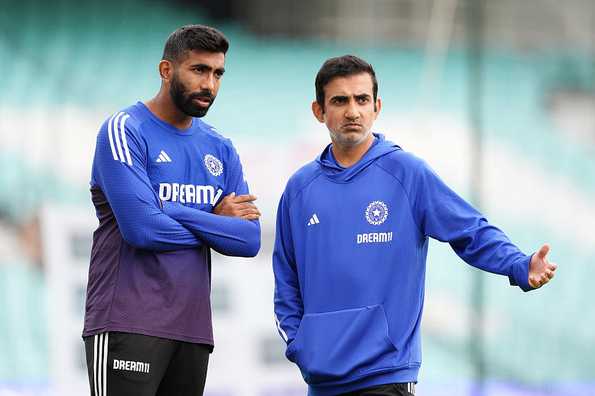
Despite the clamor for his inclusion, Bumrah remained on the sidelines, having already met his agreed-upon quota of matches.
India's batting coach, Ryan ten Doeschate, addressed the concerns, describing it as a "complex issue." He refuted suggestions that Bumrah was selectively choosing games. "He did say he was going to play three games, and he left it up to us which three he played. We've tried to manage the situation," ten Doeschate stated.
Bumrah's impact when he played was undeniable. With 14 wickets in three matches, including two five-wicket hauls and an average of 26, he ranks second only to Ben Stokes in the series' wicket-taking charts. However, those three games saw him bowl a significant 119.2 overs, a considerable workload, especially considering the relatively flat pitches. This highlights India's heavy reliance on him; he bowled nearly 40 overs per Test, only 19 fewer than Mohammed Siraj, who also faced a demanding workload in all four Tests.
Ten Doeschate emphasized the team management's priority to safeguard Bumrah's physical well-being.
"We obviously want to wheel him out, but we also want to respect where his body's at," ten Doeschate explained. "And on the basis of that, we just felt that it wasn't worth including him in the squad for The Oval Test. He has bowled a large number of overs, even though it may not seem like it because he only played three Tests and bowled in one innings in Manchester."
He reiterated that Bumrah had committed to playing three games before the tour, and the team felt it was important to honor that agreement.
Ten Doeschate shed light on the intricate decision-making process behind selecting the three Tests for Bumrah. For instance, despite a week-long break between Headingley and Edgbaston, and with India trailing 0-1, Bumrah was rested for the second Test. He returned at Lord's, which meant the management had to decide whether to use him for Old Trafford or The Oval.
"Every time I've answered this question, I've spoken about putting the pieces of the puzzles together. And guys were baffled when we didn't play him in the third [second] Test," ten Doeschate said. "Our thinking was that The Oval, yes, it's got bounce, but it's normally a fairly good wicket for batting on. And we thought if we had rolled the dice in Manchester, obviously if we had won the toss, we would have bowled. In hindsight, you would have loved to have him here. But you would also have said if we'd come here 3-1 down that we didn't use him there."
He added, "So it's trying to not guess, but trying to look into the future and then try to see how we can manage him. And maybe England have got it spot on, leaving the best bowling wicket for the last Test after he's played three."
The rotation policy extended beyond Bumrah, and ten Doeschate acknowledged its wider impact on the team's dynamics.
"It's not ideal. I guess giving those guys attention, the guys who aren't playing, particularly when you're carrying 18, is important," he said. "Make them know that you're making all the decisions in good faith, in the best interest of the team. And just on that, all the guys who haven't played, they've been fantastic. They've trained the house down. They're disappointed when they get left out. They don't let it show when they're around the group, and that's very important to creating a good culture for the guys who are playing to perform."
While Jasprit Bumrah's absence was a precautionary measure, England faces a potential forced absence due to injury. Chris Woakes, who has borne the brunt of England's bowling workload with 181 overs, sustained a suspected shoulder dislocation on Day 1 at The Oval. Scans will determine the extent of the damage.
The injury occurred during India's first innings when Woakes dived to stop a ball near the boundary. He landed awkwardly and immediately clutched his shoulder.
"I don't know too much about it, but it doesn't look great," Gus Atkinson said. "It's a big shame, last game of the series, and when anyone gets injured, it's a shame. I'm hoping it's not too bad, and whatever it is, he'll get full support from everyone."
Having played in every Test of the series and taken 11 wickets at an average of 52.18, Woakes' injury could leave England short-handed. While Atkinson is prepared to take on additional bowling responsibilities, England will miss Woakes' contributions with the bat.
"Definitely, I feel fresh, I feel good. I know I've only got this one game to play so I can push the limits a bit," Atkinson concluded.
Newer articles
Older articles

 R. Ashwin Eyes ILT20 Opportunity, Set to Enter Auction After Retirement
 'Still a long way to go' - Taskin encouraged by steps towards rediscovering rhythm
 Litton Das Reveals Colombo Pitch Preference: Mahedi Hasan Over Miraz Key to Victory
 Ankit Sharma Secures NoC from Puducherry, Eyes Kerala Move
 Decoding Urine Color: What Your Stream Reveals About Your Health
 Tamim to contest BCB polls, keeps president bid open
 Pujara Reveals Nerves Before Ringing Lord's Bell; India Aims for Test Control
 India vs England: Lord's Test Preview - History, Stats, and Key Battles
 Deepak Chahar and Wife Join Cricket Stars at Wimbledon After Kohli's Appearance
 Reddy Aims for Bowling Consistency After Lord's Test Breakthrough